Acrylic vs. Rigid PVC Shower Wall Panels – What Bathroom Remodeling Contractors Need to Know
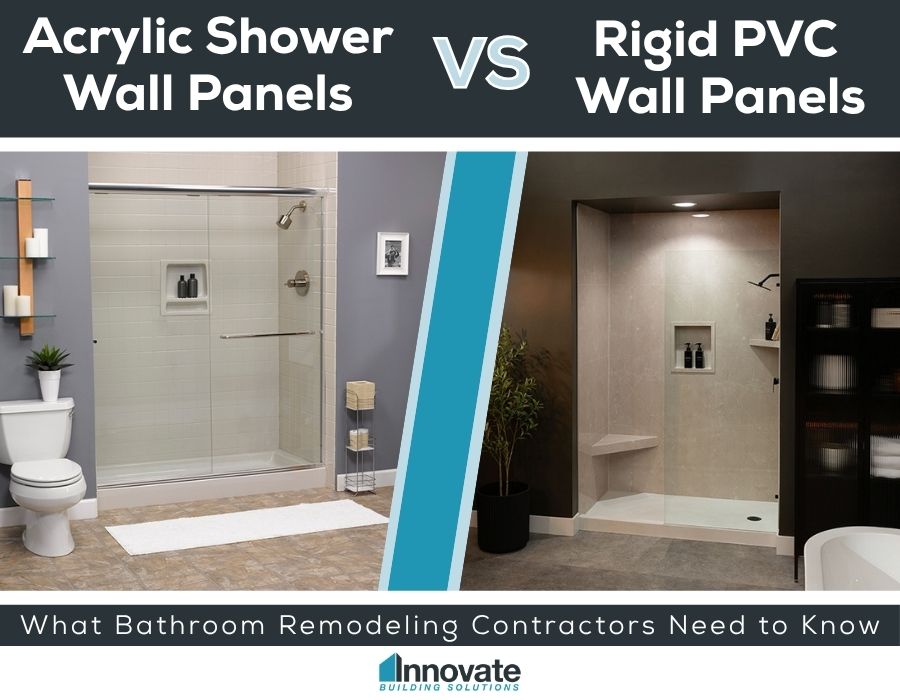
If you’ve been in the quick installation bathroom business, acrylic wall panels are likely be your ‘go to’ product option. However, with acrylic manufacturers offering dealerships to everybody and their brother (and their brother’s brother and sister), and with consumers focused on ‘affordability,’ it’s increasingly becoming a ‘race to the bottom’ to close deals for many acrylic wall panel dealers. There’s so many ‘look-alike’ acrylic wall surround products, it’s hard to separate yourself from the pack.
Or if you haven’t been in the quick installation bathroom business you may see the big franchise companies in your city scaling their businesses – with not very impressive products either. And in the meantime, your general contracting, design/build, or home access contracting business is laboring making less profits than you’d like doing tile showers and/or buying cheap (and a PITA to install, fiberglass systems from home centers). You’re looking for a more profitable wall panel alternative but are unsure what to choose. You’re wondering are you too late to enter this growing grout free surround market?
And while there are a plethora (a fancy word I threw in so you’d think I was smart…..I hope it’s working) of wall panel alternatives, two popular options include acrylic and rigid PVC shower wall panels.
In this article I’ll compare and contrast these offering to give you a practical guide to decide which is best for you and your business. To accomplish this goal, I’ll do the following
- In Section 1) Define what acrylic and rigid PVC shower, and tub surround panels are. And if you already know what they are, proceed to Section 2.
- In Section 2) Identify common mistakes bathroom remodeling contractors make who enter the quick installation bathroom market and DO NOT get the results they expected.
- In Section 3) Discuss 10 criterion to determine if acrylic or rigid PVC shower wall panels are best for your business and customers.
Now, let’s dig in.
Section 1 – What are acrylic and rigid PVC shower and tub wall panels?
What are acrylic wall panels?
Acrylic shower wall panels are vacuum formed (molded) acrylic sheets which are usually installed over moisture resistant greenboard, or in some cases (with ‘bath in a day’ companies) over tile. Most suppliers make them in 1/8” thick sheets.
They’re usually supplied in glossy patterns (although matte finish is available) and are molded as smooth sheets or with tile or stone designs. They’re 100% waterproof.
They can be purchased in ‘full sheets’ as large as 60” x 96” (common for a tub to shower conversion back wall) and/or with side walls up to 38” x 96”. The edges of an acrylic bathroom shower surround can be finished with trim pieces, or the sheets could have ‘bends’ to complete the edges.
Acrylic wall panels install quicker than tile and are simple to maintain. Individual sheets can be butted together but aren’t joined together. Acrylic can be prone to scratching or cracking.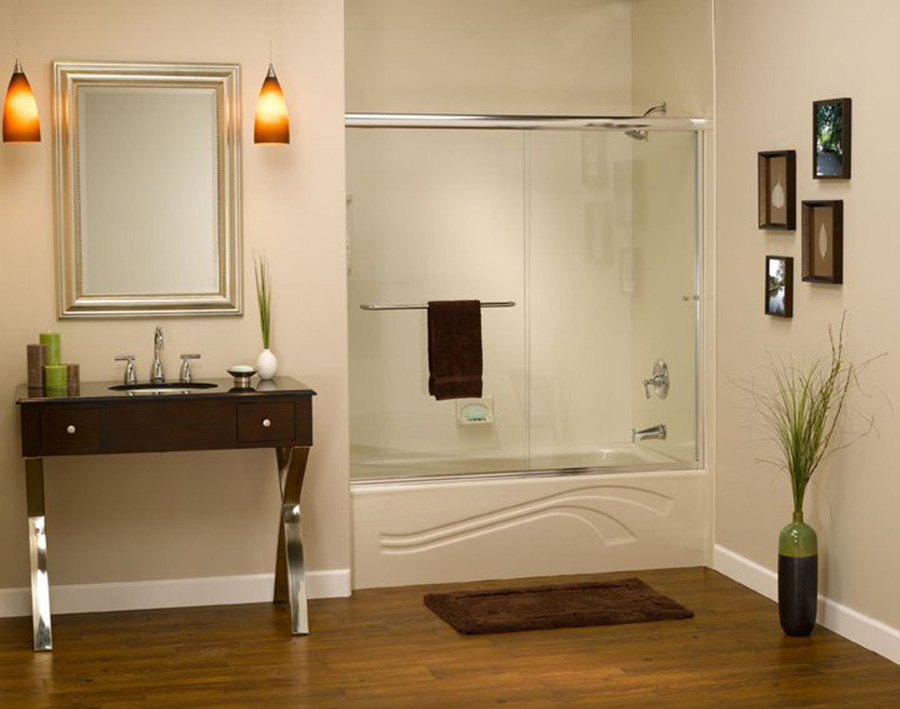
What are rigid PVC wall panels?
Rigid PVC (which stands for Polyvinyl Chloride) wall panels aren’t as well-known as acrylic wall panels but are growing rapidly.
They’re also a waterproof wall panel system. They can be installed over moisture resistant greenboard, tile, Denshield, Durock, GoBoard, HardieBacker, Fiberock, or cement board.
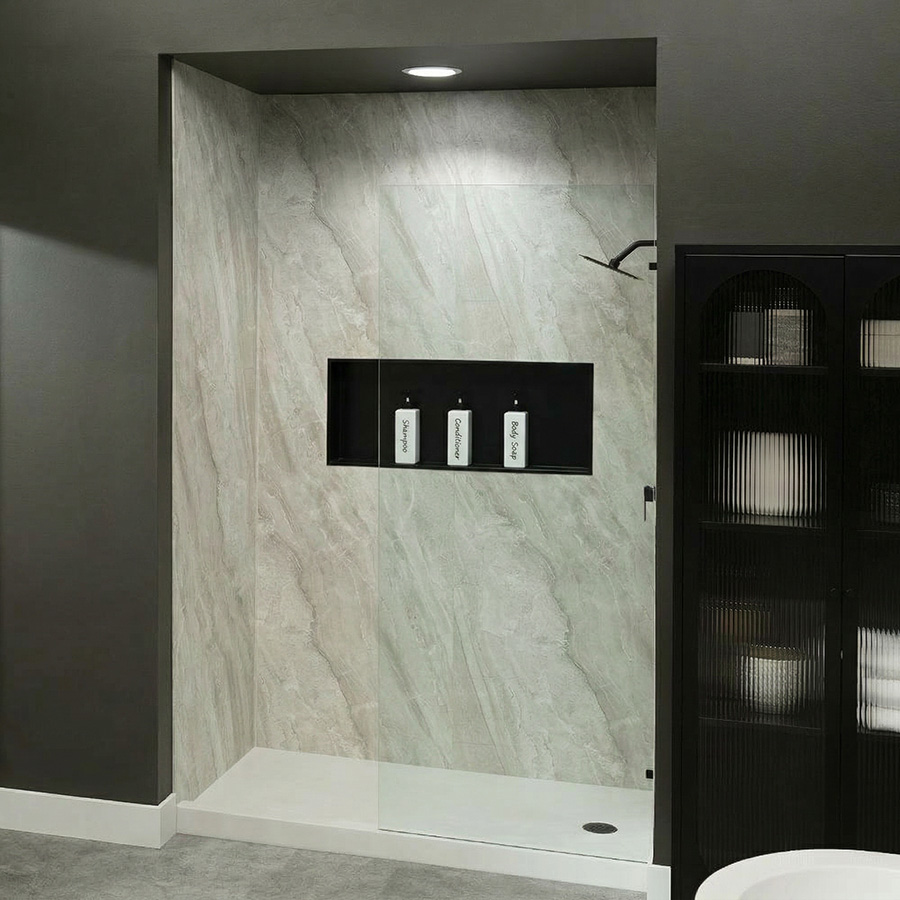
One line of rigid PVC wall panels (called PanelPro) is 60% thicker than acrylic and made from a high-tech engineered rigid PVC composition. It has a protective top layer for scratch and wear resistance, uses multi-colored film to create natural tile and polished stone looks, and is built onto a rigid core board for strength and durability.
The PanelPro rigid PVC panels are 36” x 96” and use a tongue and groove installation system where the panels are joined to make any size standard (or custom) shower or tub surround. It’s more impact resistant than thinner sheet products like acrylic or fiberglass.
Rigid PVC panels can have CNC faux grout joints which have a realistic tile or polished stone look. They’re more life-like than molded wall panels made of acrylic or fiberglass.
Section 2 – Common mistakes bathroom remodeling contractors make who enter the quick installation shower, tub, and bath surround market
While it’s not difficult to enter the quick installation bathroom remodeling market (unless you’re in a state where there’s stringent licensing requirements) – many contractors-turned-entrepreneurs find it’s not necessarily as simple to make money in this business as they thought it would be. And here’s 3 common mistakes which cause them unanticipated problems and lower profits.
- Mistake #1 – They choose to launch this business by limiting themselves to selling the materials they’ve installed before – Just because you’re familiar with installing a certain material, doesn’t mean it’s necessarily the best choice for your customers, or the most efficient system for you, or one you can make the best profits from. Before committing to a line (or lines) you not only need to understand how its installed, but also how to cost-effectively lead-generate, and have a process to close sales effectively – and efficiently.
- Mistake #2 – They don’t know how to sell based on ‘value’ – If you choose a nicer quality (higher priced) and more differentiated shower wall surround line – you need to be prepared to communicate it’s value, believe in its value, and sell it effectively. And even if you’re the best installer known to man (or woman) kind – you can’t install a job until you get a lead, then sell the job! Selling IS a necessary skill for success! And it’s hard to make money with a ‘race-to-the-bottom’ pricing approach. And if ‘cheap’ always ‘won the day,’ the big franchises wouldn’t be so big.

- Mistake #3 – You don’t consider the impact of panel size, thickness, and weight when deciding the best system(s) to offer – Wall panels (whether they’re acrylic, rigid PVC or other lines) come in multiple shapes, sizes, weights, and installation approaches. These product variations not only impact whether a job is (literally) back-breaking to do – but product sizes, thicknesses, weights, and installation systems will impact if the job is reasonably – or outrageously priced. Can you be price and cost-effective with jobs of all shapes and sizes?
Section 3 – Are acrylic or rigid PVC shower wall panels best for your business, and your customers?
Although there’s certainly pros and cons to acrylic and PVC shower, tub, and bathroom surround panels, the only thing which really matters is which system is best for your business – and your customers? Here’s 10 criterion (or decision factors) to help you wrap your arms around this question. I’ll name the ‘winning system’ at the end of each decision factor.
Criterion #1 – Which panel surround system offers more differentiation, acrylic or rigid PVC panels?
Since acrylic panels have been around for a long time, and there’s many manufacturers offering dealerships, the amount of differentiation attainable with acrylic wall panels is negligible. As a matter of fact, the largest manufacturer has even split their line into ‘different segments’ to give dealers the feeling of ‘exclusivity.’ However, most bathroom remodeling contractors using these lines would agree its more of a mirage. This lack of differentiation causes a ‘race to the bottom’ pricing especially if you’re only selling acrylic panels which are the ‘spitting-image’ of the acrylic your competitors are also ‘trying to sell.’
If you want a product with more differentiation, and the not offered by everybody in your market- rigid PVC is a sound choice.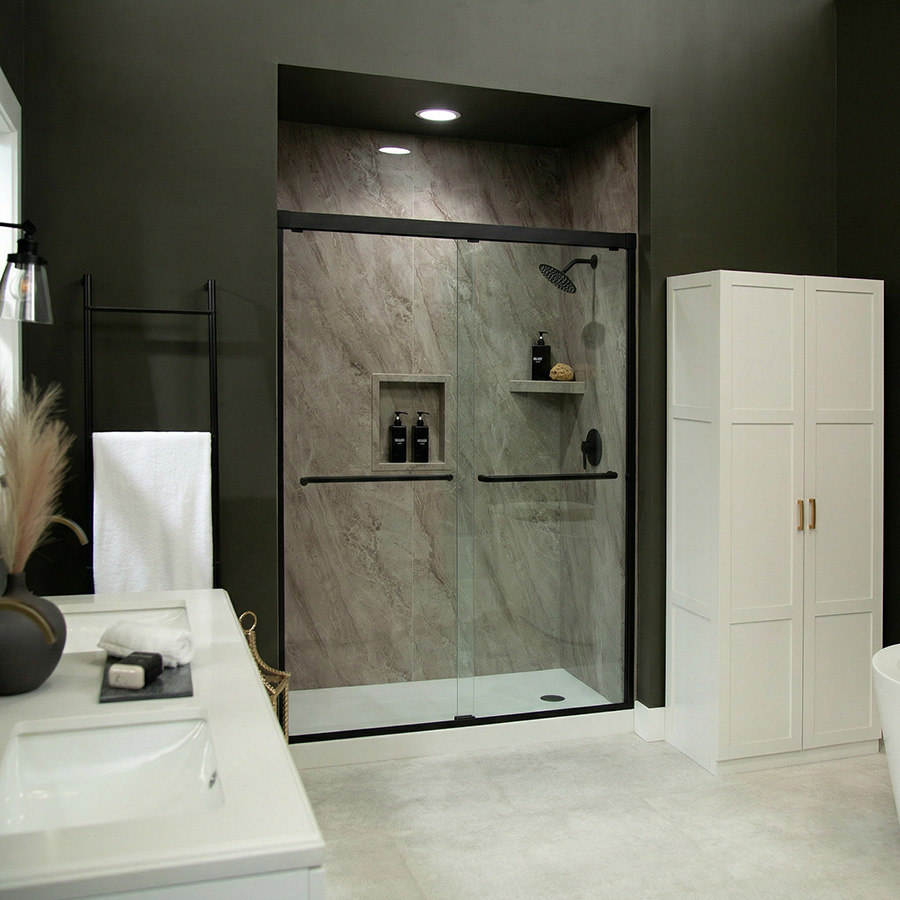
Not only are rigid PVC panels 60% thicker than acrylic (yet similarly priced), but they’re available with more realistic looking tile and stone patterns because the ‘faux joints’ are CNC routed into panels vs. being a molded sheet. Bottom line, these design advantages make them more sellable in higher value homes at better margins.
Advantage – Rigid PVC.
Criterion #2 – Which panel surround system is easier to install, acrylic or rigid PVC?
The installation of acrylic and rigid PVC is time-effective and saves significant labor hours vs. tile. There are slight nuances between the systems which may cause you to favor one or the other – depending on your POV.
With acrylic you can get a full 60” back panel for your tub to shower conversions.
However, with the rigid PVC system (which comes in 36” x 96” sheets) the tongue and groove design allows you to make any sized wall – and the ‘faux joint’ hides any seams. This is helpful for odd sized, custom projects or showers with walls larger than 60”.
Both systems have 96” tall sheets which make it time-effective to do tub to shower conversions where you want a ‘dog leg’ on the outside edge which isn’t a separate piece.
Both systems adhere to various backer boards with adhesive.
Another advantage of the rigid PVC is there’s inside corner trims which give you ‘wiggle room’ if your wall is out of square or the cuts aren’t perfect (although I’M SURE this has NEVER happened on one of your jobs – ha! ha!). In addition, there’s no visible sealant in the corners with rigid PVC, which customers love (less maintenance).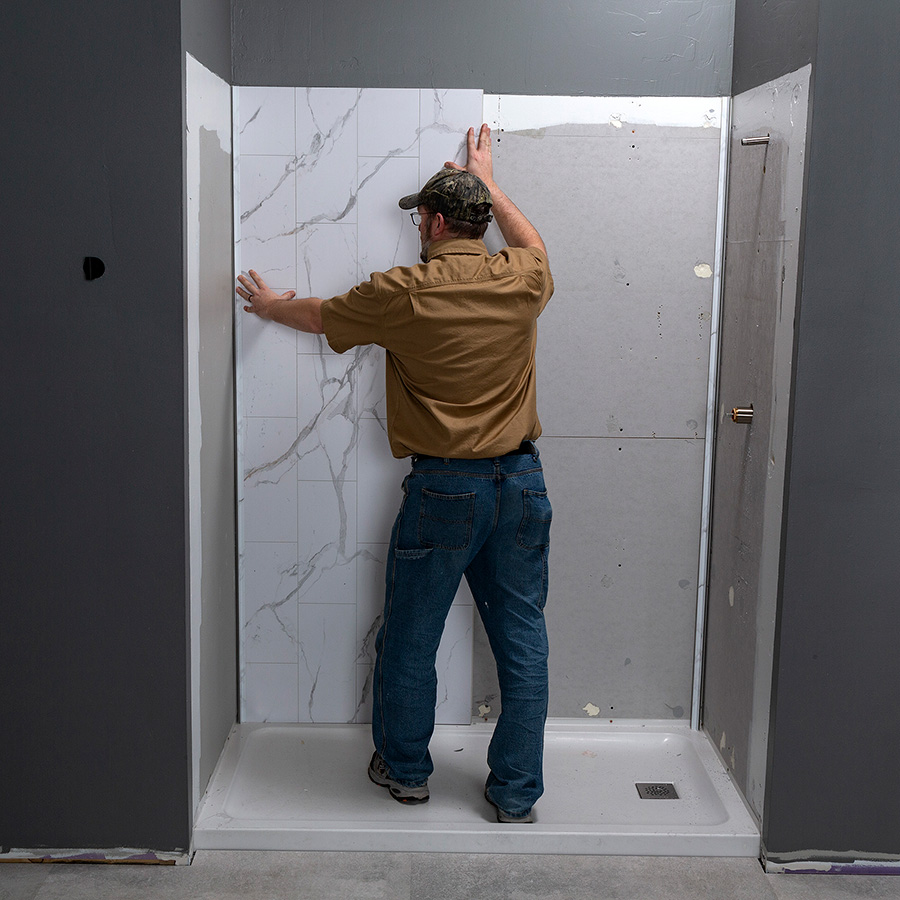
Advantage – Toss-up.
Criterion #3 – Which panel surround system offers better profit margins, acrylic or rigid PVC?
While profit margins are impacted by the efficiency of how you buy, the productivity of your crews, your ability to not have marketing costs bury you, and the ability of your salesperson to sell based on value (not just on price), rigid PVC panels offer a dealer a higher profit margin. And right now – especially if you’re an acrylic dealer – you may be saying, “Mike, what makes you say that?”
Well – here’s why. There are soooo many acrylic wall panel installing contractors you can’t even ‘shake a stick at them’ (unless you have a LOT of sticks!). At a recent home show in Cleveland Ohio, I counted 8 companies displaying acrylic shower wall panels! Ouch, that doesn’t bode well for your profitability if customers are ‘shopping you (and your competitors) until they drop!’ You WILL NOT run into this oversaturated competitive environment with rigid PVC.
And since rigid PVC shower wall panels are thicker, with more realistic patterns, even a half-decent sales person should be able to get a few bucks more for these jobs.
Advantage – Rigid PVC.
Criterion #4 – Are acrylic, or rigid PVC shower, tub, and bathroom surround panels cheaper to buy?
It depends. Now, there’s a ‘Switzerland’ answer for you!
If you’re a high-volume buyer, buy in bulk, and have a warehouse and lift truck, you’ll find the 1/8” thick acrylic panels to be slightly more cost-effective (although you’ll want to take into account the acrylic crates take up a TON of room in your warehouse).
And if you’re a small to medium sized contractor, buying rigid PVC panels can be lower cost for you. The reason is this. Since rigid PVC panels can be shipped with a liftgate delivery (because the crates don’t have to be so big with the 36” wide tongue and groove system) you can cost-effectively order one system, two systems, or any number of systems you’d like. You won’t have to wait until you can afford a $5,000 minimum order for free shipment – or get hammered (no construction pun intended) after the fact with a huge freight bill for a single order.
Advantage – In large ‘bulk buy’s (acrylic) and in smaller ‘1, 2, or 3 shower systems at a time buy’s (rigid PVC).
Criterion #5 – Are acrylic, or rigid PVC shower, tub, and bathroom surround panels more durable?
This is an easy one. Rigid PVC is more durable.
The reasons are:
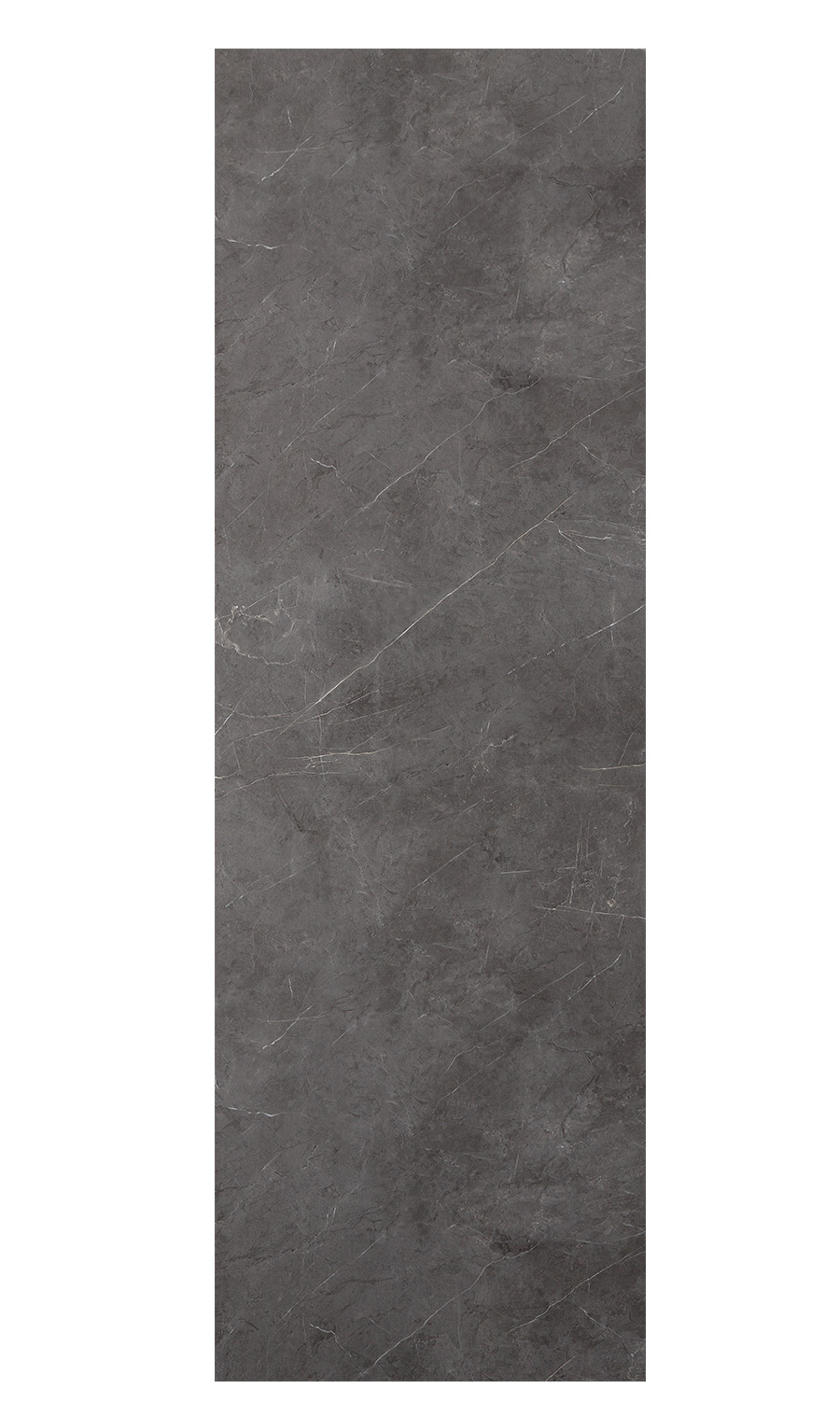
- It’s higher density. These 3’ x 8’ panels weigh 41 lbs.
- It’s 60% thicker at .200” thick vs. .125” thick.
- It’s thickness provides more substance behind the surface and makes it harder to crack during cutting, shipment, or installation.
Advantage – Rigid PVC.
Criterion #6 – Are acrylic or rigid PVC wall panels simpler to maintain and/or easier for a client who needs an age in place, or accessible shower?
Both systems are easy to clean.
Certainly, an important reason to use any type of grout free wall panels is to make the shower simpler to care for, minimize places where mold can grow, and keep elderly parents off their hands and knees cleaning tile grout joints!
The one slight advantage I’d give to rigid PVC is the inside corner trims provide two less places where sealant can age over time (unlike the visible sealant in the corners of an acrylic tub or shower installation).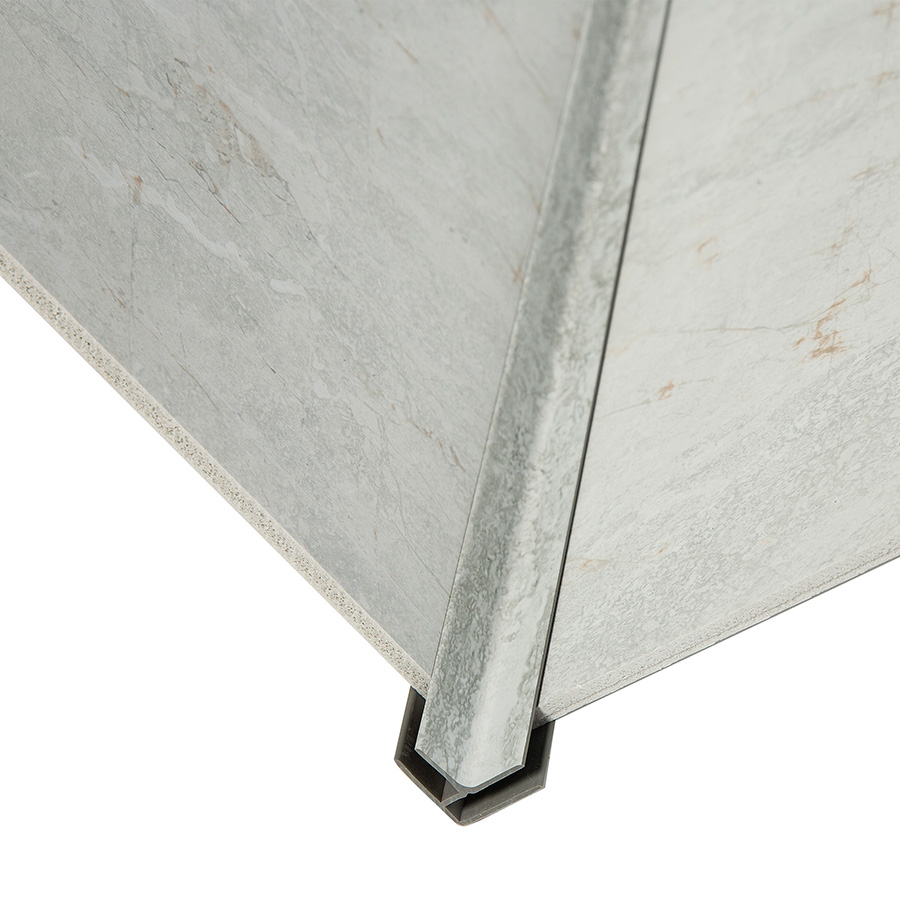
(Slight) Advantage – Rigid PVC.
Criterion #7 – Do acrylic or rigid PVC wall panels offer more design flexibility?
While this seems like a straightforward question, the answer(s) depend on what type of ‘design flexibility’ you need. Here’s 4 factors to evaluate which system is best for the ‘particular type’ of design flexibility you need:
- Factor #1) If you need ‘size’ design flexibility. In this case the rigid PVC is the way to go because you can join together (using the tongue and groove panel design) with as many – or as few panels you need create the wall size(s) you need. For example, if you have a 10’ wall going from the shower surround into the bathroom– you’d simply join enough 3’ wide panels (4 in this case) to cover the wall and cut any excess. You wouldn’t see any baton strips – just one long wall of wall panels. Bottom line – you can get a ‘seamless look’ in any size with the rigid PVC, even in walls are longer than 60”! Advantage – Rigid PVC
- Factor #2) If you need ‘pattern’ flexibility – Since acrylic wall panels have been out for so long – and they’re made to order (vs. the rigid PVC in stock selections)– you’ll find broader offerings and pattern/color combinations (as long as you can wait for them). Advantage – Acrylic
- Factor #3) If you need ‘height’ flexibility – If you have a customer with a 9’ and 10’ ceilings – and they insist on wall coverage to the top, you can get ‘non-stock’ rigid PVC panels made to fit. Advantage – Rigid PVC.
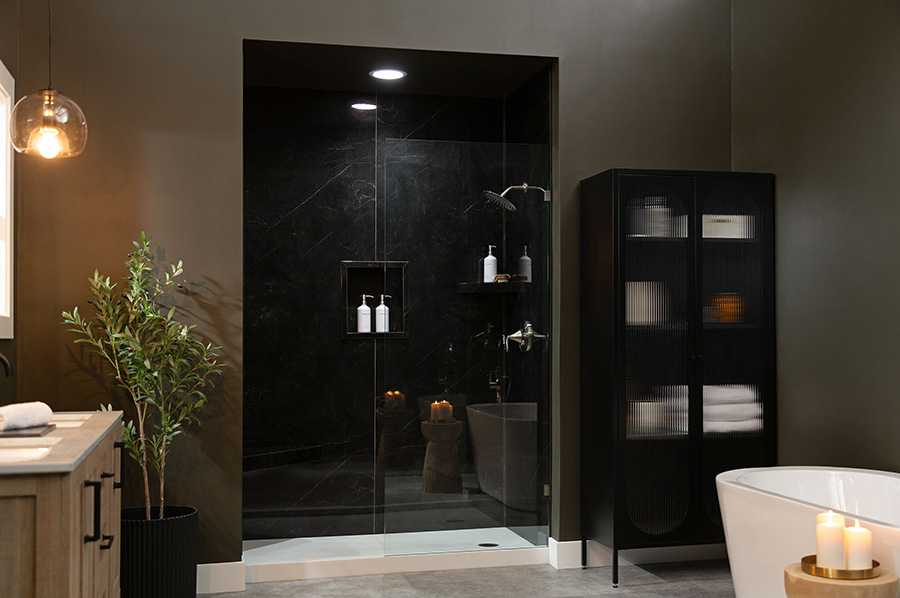
- Factor #4) If you need ‘finish’ flexibility – Both acrylic and rigid PVC panels are available in matte and gloss finishes. One cool option in rigid PVC are the polished stone shower surrounds which are an ‘ultra-high-gloss’ look. They make a bold statement. Overall, however, you can get finish flexibility in both lines.
Advantage – Toss-up.
Criterion #8 – Does acrylic or rigid PVC wall panels offer more matching shower accessory options? And are ‘matching accessories’ really important?
Since acrylic wall panels (and the manufacturers who supply them) have been around for years, you’ll find the widest range of matching accessories offered by these companies. Although you’ll also find matching niches, corner shelves, and fixed corner bench seats in the rigid PVC line with a better quality look.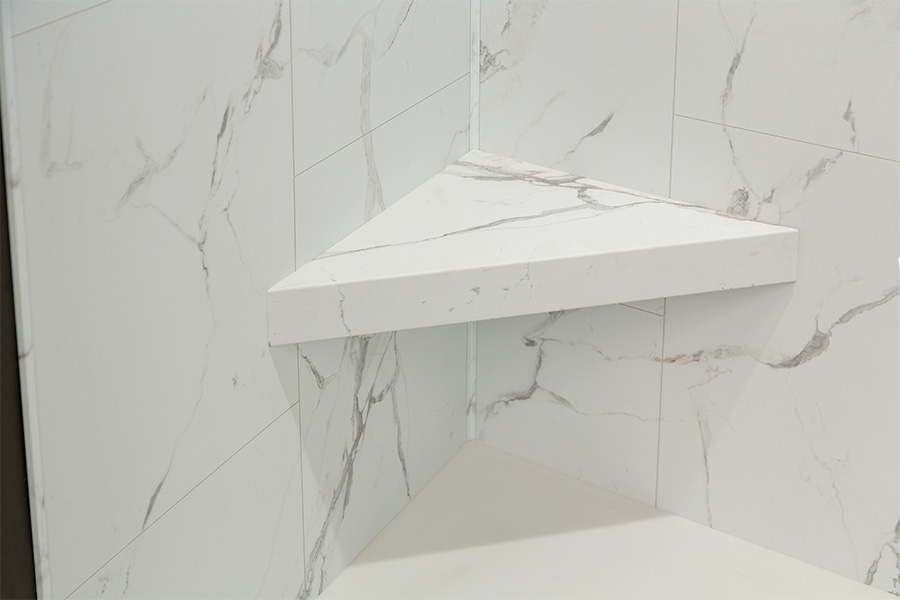
And while acrylic has a lot of matching options – I’d argue many of these corner shower caddies look cheap and fake.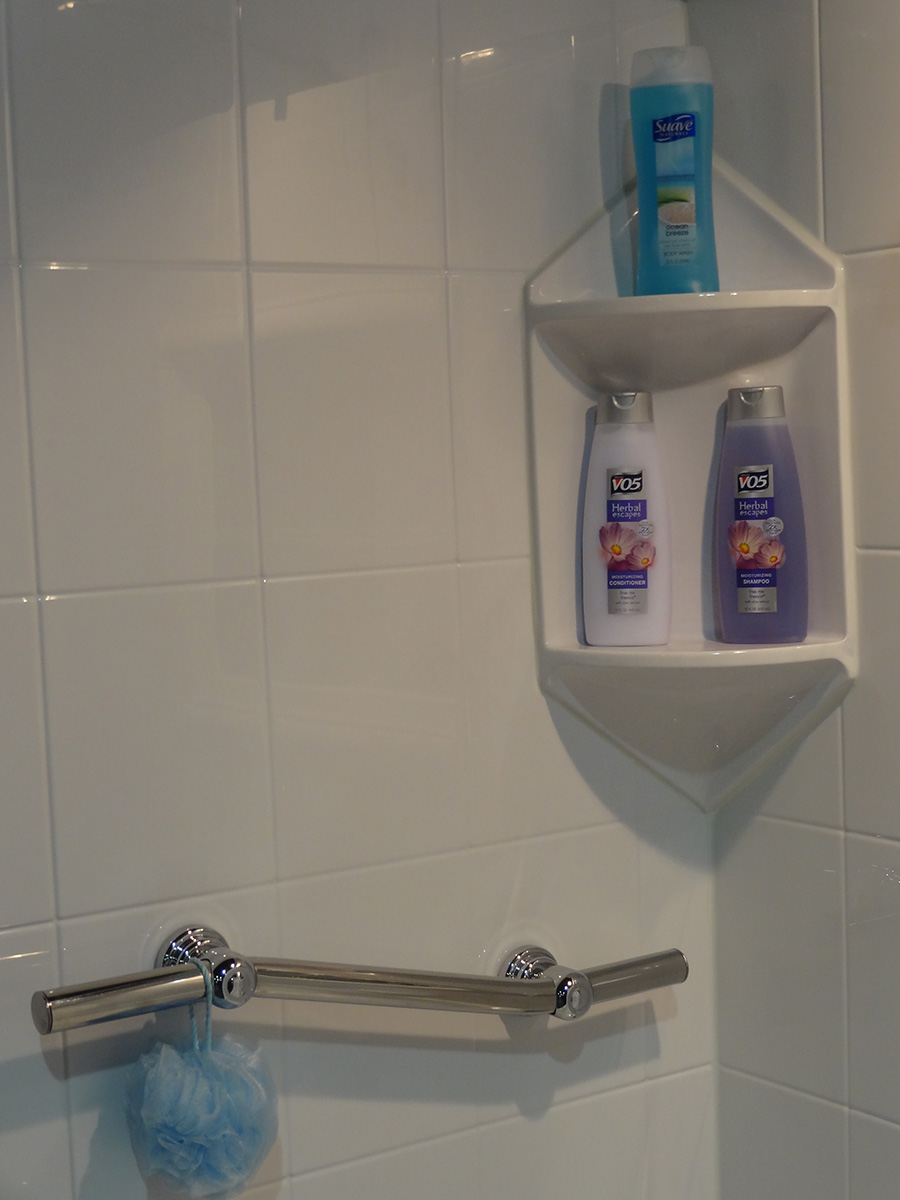
So, why show matching accessories at all, you might ask? Well one good reason is selection decisions can slow down the sales process. So, while ‘matchy-matchy’ isn’t really ‘in’ if you ask fancy-schmancy designers – when it comes to grout free wall surround customers, sometimes they want you (and they NEED YOU –like this famous line from A Few Good Men) to make the selection process easier.
So, for matching accessories…
Advantage (for number of matching accessories offered)– Acrylic.
Advantage (for look of matching accessories) – Rigid PVC.
Criterion #9 – Will acrylic or rigid PVC wall panels have less call backs?
Since both products have ‘flexibility’ in their material composition, (and aren’t prone to cracking after they’re installed) are UV protected, have ZERO grout joints, call backs aren’t a frequent occurrence. However, one of the biggest complaints about any grout free system is the exposed sealant.
However, the rigid PVC will have slightly less call backs (especially complaints about sealant) because the inside corner trims have the sealant inside the trims – and not visible at the surface – to minimize this customer concern.
(Slight) Advantage – Rigid PVC.
Criterion #10– Is it quicker to get rigid PVC, or acrylic wall panels if I need to turn a job around quickly? Which panel can be more efficiently stored AND received, even if I don’t have a lift truck, or I want a job site delivery?
If, for example, you’re a home access contractor who focuses on client’s who’ve suffered injuries or are elderly (and no I DO NOT include myself in that category, although maybe others might, behind my back!) – and all of sudden can no longer climb over a tub surround, the need to get product quickly can be essential for your business to thrive. For projects like these, rigid PVC is the way to go because the 36” x 96” panels are in stock, and ready to ship immediately.
And if you’ve got a small shop – or no shop at all – you know ‘trying’ to get wall surround and base deliveries in their oversized crates (with acrylic 60” back wall panels, bases, you name it) can be an impossible dream. The manufacturers – and freight companies really don’t want to help or work with you. As a small to mid-sized contractor rigid PVC panels are the smartest option because the panels are shipped flat (not upright on a HUGE skid). They come in a space-effective crate, and because they’re not too large, you can get a liftgate shop delivery (even if you don’t have a lift truck), or a job site delivery.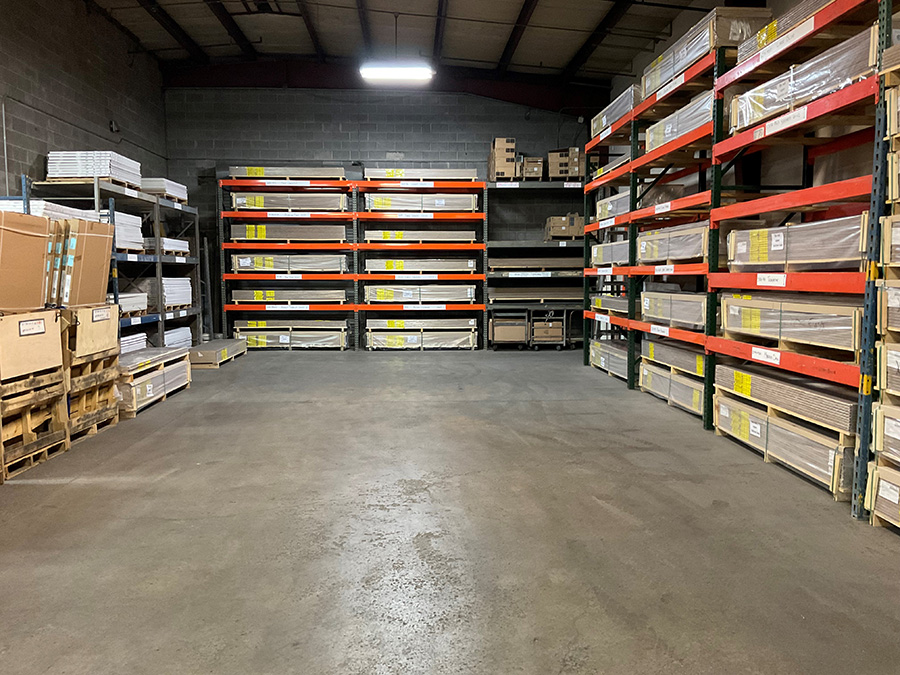
(BIG) Advantage – Rigid PVC.
So, given what you learned above are acrylic – or rigid PVC shower surround panels, right for your business and customers?
So, after learning about the merits between acrylic and rigid PVC surround panels – and the common mistakes people make when launching a quick installation shower business – is one line a ‘slam-dunk’ better option for you and your customers?
If you have an opinion comment below.
And if you’re not sure which could be better for you and your customers, and need to research further, here’s what you can do:
- Request free samples. Let’s face it, lots of things look good on the Internet. Then you get samples (or worse yet, order a full project) and they’re a pile of junk. Get samples – or better yet, visit a showroom where you can see the product installed in a real setting.
- Request pricing. In this competitive world you need to know what your costs are. And not just the FOB factory costs. I’m talking about delivered costs to you, and your job. You need the ‘all in costs’ for materials and labor to determine what’s best.
- Download a PanelPro rigid PVC dealer brochure – or request a brochure from an acrylic supplier.
- Call a rigid PVC supplier (at 888-467-7488), or an acrylic supplier to get their input on which is best. And yes, I’ll come clean (no shower pun intended) and let you know one of the products my company supplies to our dealer network are rigid PVC panels.
And while this article presented the decision to use either acrylic or rigid PVC wall panels – in reality it’s NOT an ‘either-or’ proposition. Like I tell bathroom contractors all the time, “Wall panels are like people. They all have their strengths and weaknesses. And ANYONE who tells you their line is the ‘end-all-be-all’ is flat out lying to you.”
Do your research. Get the straight scoop. Try both alternatives to see which stacks up best.
And if you’d like to learn about A PanelPro dealership with PVC shower wall panels – including the samples, sales kit, and in-home sales program call me at 888-467-7488 or click to learn more about our Bath Products Dealership program.
Thanks for reading and putting up with my wackiness along the way.
Mike
Mike Foti, President, Innovate Building Solutions
Tags: bath remodeling dealership, bathroom dealership programs, bathroom remodeling contractors, become a 1 day bathroom dealer, better line of shower surrounds, common start up mistakes for one day bath companies, design-build remodeler growth ideas, glue up wall panel systems, higher end quick install bathrooms, options to acrylic wall panel dealership, PanelPro, PanelPro dealers, PanelPro rigid PVC shower panels, PanelPro shower wall panels, PVC shower systems for contractors, PVC wall panel dealership, quick installation bathroom, quick installation bathroom business, quick installation bathroom dealers, quick installation bathroom products, quick installation bathroom remodeling market, quick installation shower business, rigid PVC shower, rigid PVC shower wall panels, rigid PVC wall panel dealership, unique shower wall panel dealership, wall panels for bathroom remodeling contractors

Mike Foti